
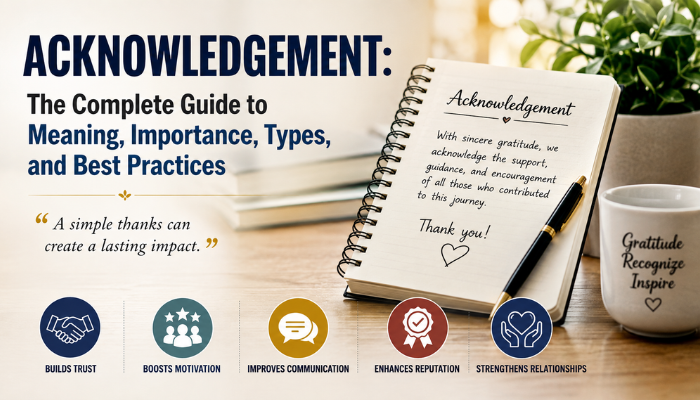
Acknowledgement is a simple yet powerful act that strengthens relationships, recognizes contributions, and promotes respect in both personal and professional settings. Whether it appears in a research paper, a business email, a book, or a workplace conversation, acknowledgement serves as an expression of gratitude and recognition for the support, effort, or assistance provided by others.
In today’s interconnected world, acknowledgement has become more important than ever. People appreciate being recognized for their hard work, ideas, and contributions. From academic writing to corporate environments and everyday interactions, proper acknowledgement fosters trust, motivates individuals, and creates positive experiences. This comprehensive guide explores the meaning of acknowledgement, its significance, different types, practical writing techniques, common mistakes, and frequently asked questions to help you master this essential communication skill.
Understanding Acknowledgement and Why It Matters
Acknowledgement refers to the act of recognizing, appreciating, or accepting someone’s contribution, support, achievement, or existence. It can be formal or informal depending on the situation. In academic writing, acknowledgement allows authors to thank supervisors, mentors, institutions, and individuals who contributed to their work. In business, acknowledgement often confirms receipt of information or recognizes employees for exceptional performance.
Beyond its literal meaning, acknowledgement reflects emotional intelligence and professionalism. People naturally value appreciation because it validates their efforts. When organizations consistently acknowledge employees, productivity and morale often improve. Likewise, individuals who acknowledge others build stronger relationships based on mutual respect and trust.
Acknowledgement also plays an important role in communication. It prevents misunderstandings by confirming that information has been received and understood. For example, acknowledging an email assures the sender that their message reached the intended recipient. Similarly, acknowledging customer concerns demonstrates responsiveness and commitment to quality service.
In everyday life, acknowledgement strengthens friendships, family bonds, and social interactions. Even a simple “thank you” or recognition of someone’s effort can leave a lasting positive impression. This makes acknowledgement not merely a courtesy but a valuable interpersonal skill.
Different Types of Acknowledgement
Acknowledgement appears in various forms depending on the context. Understanding these different types helps people communicate more effectively and appropriately.
One of the most common forms is academic acknowledgement. Students, researchers, and scholars include acknowledgement sections in dissertations, theses, research papers, and projects. These sections recognize professors, advisors, funding organizations, colleagues, friends, and family members who supported the research journey. Academic acknowledgement demonstrates integrity and appreciation while giving proper credit to contributors.
Another widely used form is professional acknowledgement. Businesses acknowledge customer inquiries, employee achievements, project contributions, and official communications. Employee recognition programs often rely on acknowledgement to improve motivation and workplace satisfaction. Organizations that consistently acknowledge good performance typically experience better employee engagement and retention.
Personal acknowledgement is equally meaningful. It includes expressing gratitude to family members, friends, mentors, or community members who provide emotional or practical support. Whether through handwritten notes, speeches, or verbal appreciation, personal acknowledgement strengthens human connections.
Digital acknowledgement has become increasingly common in today’s technology-driven environment. Email confirmations, automated responses, social media mentions, online reviews, and customer feedback acknowledgements ensure timely communication. Businesses that promptly acknowledge customers online often enhance their reputation and customer loyalty.
How to Write an Effective Acknowledgement
Writing an effective acknowledgement requires sincerity, clarity, and organization. Whether preparing a thesis acknowledgement or a professional message, begin by identifying everyone who genuinely contributed to your work or success. Prioritize individuals according to the significance of their contributions while maintaining respectful language.
A typical acknowledgement starts by thanking primary contributors, such as supervisors, mentors, managers, or institutions. It then moves toward colleagues, peers, friends, and family members. The tone should remain professional, concise, and authentic throughout the text. Avoid excessive praise or exaggerated language that may reduce credibility.
For academic acknowledgement, mention advisors who guided your research, committee members who reviewed your work, funding organizations that provided financial assistance, and family members who offered emotional encouragement. Each acknowledgement should explain how the individual or organization contributed to the project.
In business settings, acknowledgement messages should be prompt and specific. For example, when acknowledging receipt of an email, clearly confirm that the information has been received and mention any next steps if applicable. Employee acknowledgement should highlight specific accomplishments rather than using generic compliments. This personalized approach increases the impact of recognition.
Finally, always proofread your acknowledgement carefully. Misspelled names, incorrect titles, or omitted contributors can unintentionally offend those you intended to appreciate. Accuracy demonstrates respect and professionalism.
Benefits of Acknowledgement in Personal and Professional Life
Acknowledgement delivers numerous psychological, social, and organizational benefits. At the individual level, recognition increases confidence, motivation, and emotional well-being. People who feel acknowledged are more likely to remain engaged, cooperative, and committed to shared goals.
In workplaces, acknowledgement contributes significantly to employee satisfaction. Organizations that celebrate achievements, recognize innovation, and appreciate dedication often experience lower turnover rates and higher productivity. Employees become more motivated when they know their efforts are noticed and valued by leadership.
Acknowledgement also enhances leadership effectiveness. Successful leaders understand that recognition builds loyalty and trust. Rather than focusing solely on correcting mistakes, they consistently acknowledge positive contributions. This balanced approach creates healthier workplace cultures where employees feel respected and encouraged to perform their best.
In educational environments, acknowledgement inspires students and researchers to continue striving for excellence. Teachers who recognize student achievements create supportive learning environments that encourage participation and confidence. Similarly, academic acknowledgement promotes ethical scholarship by giving proper credit to those who contribute to research and knowledge creation.
On a personal level, acknowledgement improves relationships by expressing appreciation and validating others’ efforts. Whether thanking parents for lifelong support or recognizing a friend’s kindness, acknowledgement nurtures deeper emotional connections and mutual respect.
Common Mistakes to Avoid When Writing Acknowledgement
Although acknowledgement seems straightforward, many people make avoidable mistakes that reduce its effectiveness. One common error is being too vague. Simply writing “Thanks to everyone” lacks sincerity and fails to recognize individual contributions. Instead, specify how each person helped or supported your work.
Another mistake involves making the acknowledgement excessively long. While appreciation is valuable, lengthy descriptions can distract readers from the main content. Focus on meaningful contributions and maintain a logical structure throughout the acknowledgement.
Some writers accidentally omit important contributors. Before finalizing your acknowledgement, carefully review everyone who played a significant role in your success. Forgetting a supervisor, mentor, collaborator, or sponsor may unintentionally damage professional relationships.
Using overly emotional or exaggerated language is another common issue. While gratitude should feel genuine, maintaining appropriate professionalism is essential, especially in academic and business contexts. Avoid exaggerated praise that may appear insincere or unbalanced.
Poor grammar and spelling errors can also weaken the impact of an acknowledgement. Double-check names, job titles, institutions, and punctuation before publication. A polished acknowledgement reflects attention to detail and respect for those being recognized.
Ultimately, effective acknowledgement balances gratitude, professionalism, clarity, and authenticity. When thoughtfully written, it leaves readers with a positive impression while honoring those who contributed to your journey.
Conclusion
Acknowledgement is far more than a formal expression of thanks. It is a meaningful practice that recognizes contributions, builds trust, strengthens relationships, and encourages continued collaboration. Whether used in academic writing, professional communication, business operations, or everyday life, acknowledgement demonstrates appreciation and respect for the people who make success possible.
Learning how to write sincere and well-structured acknowledgement messages helps individuals communicate more effectively while fostering stronger personal and professional connections. By recognizing others thoughtfully and consistently, you create an environment where people feel valued, motivated, and inspired to contribute their best. In every aspect of life, acknowledgement remains one of the simplest yet most impactful ways to show gratitude and build lasting relationships.
Frequently Asked Questions (FAQs)
1. What is acknowledgement?
Acknowledgement is the act of recognizing, appreciating, or confirming someone’s contribution, support, effort, or communication.
2. Why is acknowledgement important?
Acknowledgement builds trust, strengthens relationships, improves communication, and motivates people by making them feel valued.
3. Where is acknowledgement commonly used?
It is commonly used in academic papers, books, research projects, business communications, workplaces, speeches, and personal messages.
4. How long should an acknowledgement section be?
An acknowledgement section is typically between 100 and 500 words, depending on the purpose and number of contributors.
5. Who should be included in an academic acknowledgement?
Academic acknowledgements often include supervisors, advisors, committee members, institutions, funding organizations, colleagues, friends, and family.
6. What is the difference between acknowledgement and appreciation?
Acknowledgement recognizes a contribution or effort, while appreciation expresses gratitude and admiration. The two often complement each other.
7. Can acknowledgement improve workplace productivity?
Yes. Employee acknowledgement increases motivation, engagement, job satisfaction, and overall organizational performance.
8. Should acknowledgement be formal or informal?
The tone depends on the context. Academic and professional acknowledgements are generally formal, while personal acknowledgements may be more conversational.
9. What are common mistakes in writing acknowledgement?
Common mistakes include being too vague, forgetting contributors, using excessive praise, writing overly long sections, and making grammatical errors.
10. How can I write a meaningful acknowledgement?
Write sincerely, mention contributors by name, explain their specific support, maintain a logical structure, and proofread carefully before sharing.
About the Author